Husband Catulle Mendès, Partner Suzanne Meyer-Zundel
Queer Places:
30 Rue Washington, 75008 Paris, France
8 Passage Norroy, 35800 Dinard, France
Cimetière de Saint-Énogat, Rue de l'Épave, 35800 Dinard, France
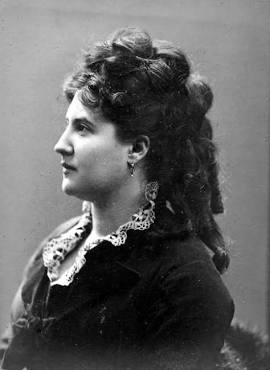 Judith Gautier (August 25, 1845 – December 26, 1917) was a French writer. The web of relationships in nineteenth-century French literary and musical circles was incredibly
modern, often completely bypassing the rigid heterosexual standards of the era. At the center of much of this was Judith Gautier.
Judith Gautier (August 25, 1845 – December 26, 1917) was a French writer. The web of relationships in nineteenth-century French literary and musical circles was incredibly
modern, often completely bypassing the rigid heterosexual standards of the era. At the center of much of this was Judith Gautier.
While her husband Catulle Mendès openly cohabitated with the composer
Augusta Holmès, Gautier carved out an extraordinary life of her own as a pioneering intellectual, translator, and novelist. In
her later years, she also formed a deeply significant, unconventional partnership with a woman, Suzanne Meyer-Zundel, that
became the emotional anchor of her life.
Born in Paris, Judith Gautier was the daughter of the famous Romantic writer Théophile Gautier and the Italian singer Ernesta Grisi. She was a brilliant scholar of East
Asian languages and culture at a time when women were largely excluded from academia.
In 1867, she published Le Livre de Jade (The Book of Jade), a highly acclaimed collection of translated Chinese poetry that influenced writers like
Ezra Pound.
In 1910, she became the first woman elected to the Académie Goncourt, France's prestigious literary society.
She married the poet Catulle Mendès in 1866. It was an unhappy, brief marriage. They separated in 1874, though they did not officially divorce until 1896.
During the late summer of 1876, Judith had a brief but incredibly passionate affair with Richard Wagner. She became his muse
during the composition of his final opera, Parsifal, and they exchanged secret, highly charged love letters behind the back of Wagner’s wife, Cosima.
While Judith's heterosexual affairs with figures like Wagner and Victor Hugo are well-documented, her most enduring romantic and domestic relationship was with a woman:
Suzanne Meyer-Zundel (1882–1971).
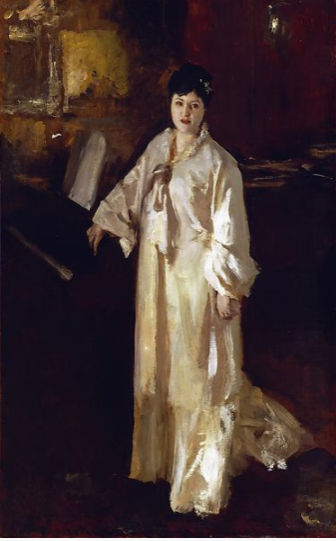
Judith Gautier,ca. 1885, John Singer Sargent American (housed at the Met)
In 1904, when Judith was nearly 60, she met Suzanne Meyer-Zundel, a young artist who worked in part by modeling intricate flowers out of breadcrumbs. Despite their age
difference, the two quickly became inseparable.
Suzanne moved into Judith's Paris apartment and accompanied her to her seaside villa in Brittany. They shared a deep passion for Asian art, myths, and legends. Suzanne
even began writing her own mythological texts under the pseudonym "Zanzim."
Because lesbian relationships in Belle Époque Paris were often coded as "passionate friendships," their domestic setup allowed them to live together relatively
undisturbed. However, those close to them understood the depth of their bond:
Some contemporary observers disconcertedly termed their relationship a "marriage," while others characterized it as an intensely devoted, protective partnership.
Suzanne was Judith’s primary legatee and dedicated herself to preserving Judith’s literary archive and collection of Asian art after Judith's death in 1917.
For a woman who spent her youth navigating the turbulent, often exhausting egos of nineteenth-century male geniuses, her quiet, decades-long life with Suzanne provided
the peace and emotional stability that had eluded her for most of her life.
References:
- https://en.wikipedia.org/wiki/Judith_Gautier
- https://libraetd.lib.virginia.edu/public_view/zp38wc65b
- https://www.encyclopedia.com/women/encyclopedias-almanacs-transcripts-and-maps/gautier-judith-1845-1917
- https://fantasy-hive.co.uk/2022/12/behind-the-screen-of-silk-and-gold-judith-gautier-guest-post-by-jean-marc-randy-lofficier-brian-stableford/
- https://agorha.inha.fr/ark:/54721/5ede06d5-3589-4ce4-80a1-cba5e278b352
Support this project
This website is a passion project researched, developed, and funded entirely by me. If you find the content valuable and would like to help support the ongoing research and hosting costs, any contribution is deeply appreciated.
Thank you for keeping this independent resource alive!
My books on Amazon: Elisa Rolle's books
BACK TO HOME PAGE